
Healthcare organisations currently face a wide range of new themes, topics and challenges around data exchange and interoperability, and this will keep evolving in the near future.
The healthcare integration landscape is changing. Healthcare organisations are dealing now, and will be dealing in the coming period, with a range of (new) themes, topics and challenges related to data exchange and interoperability. An iPaaS gives organisations the tools to take control of how this is carried out and filled in themselves, and so to bring ownership of that data back into line with responsibility for that data.
We can't answer the question in the title for you as an organisation.
What we can tell you is why it is so important to ask it in the first place.
iPaaS, the next step in enterprise integration
An Integration Platform as a Service (iPaaS) is a set of cloud solutions that lets you connect different systems within and between organisations, whether they run in the cloud or on premises. iPaaS simplifies integrating data, synchronising workflows, connecting applications and managing APIs. It also makes developing integration solutions a lot simpler. The core principles of iPaaS are simplicity, reusability and accessibility.
iPaaS can be seen as the next step in the evolution of integration solutions, building on older technologies such as ETL (Extract, Transform, Load) and EAI/ESB (Enterprise Application Integration/Enterprise Service Bus).
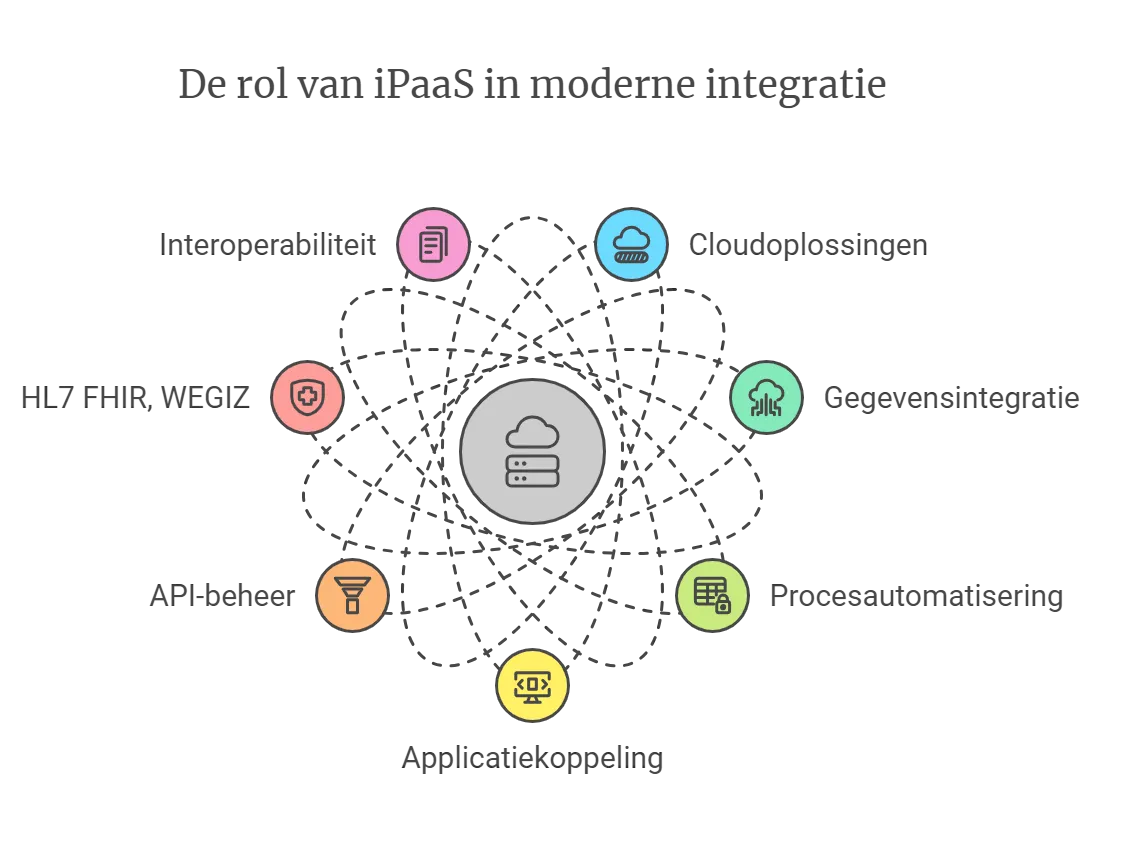
iPaaS plays an important role in several current topics in healthcare, such as HL7 FHIR (a standard for exchanging medical data), improving data availability, the Dutch Electronic Data Exchange in Healthcare Act (Wegiz), interoperability between systems, an API-first approach, the European Health Data Space (EHDS), the Cumuluz project, data platforms and Software as a Service (SaaS).
But things are going fine as they are, aren't they?
Let's first look at that question, "why should I, as an organisation, look at using an iPaaS at all?", because "things are going fine as they are, aren't they?".
It's important to answer this question seriously, because the integration landscape has changed considerably in recent years, and those changes will only increase.
In both application and infrastructure contexts, there is a shift from on-premises to cloud/SaaS solutions. We also see broader adoption and standardisation of APIs as interfaces. Although this transition has been under way for years in non-healthcare systems, more and more healthcare systems will follow this trend, certainly with the introduction of HL7 FHIR as the standard for data exchange between healthcare systems and the Wegiz, which pushes in the same direction.
At a strategic level, we see a change in mindset or integration approach: a transformation from specific exchange to generic availability, in other words data availability. Tim Postema of Nictiz wrote an apt piece about this early last year. Using Lego bricks and puzzle pieces, he describes its essence very vividly: information must not only be available, but also usable and accessible. The focus must be on standardising those puzzle pieces, separately from any one puzzle, so they can be used flexibly for every puzzle. (Re)usable, accessible and supported by implementing generic APIs as power sockets.
For a healthcare organisation to take control itself of the further rollout and realisation of this change in integration, an integration solution built on the same principles and techniques offers the opportunity: the Integration Platform as a Service (iPaaS).
What if we don't?
It's important to realise that working without an iPaaS can lead to considerable challenges and limitations.
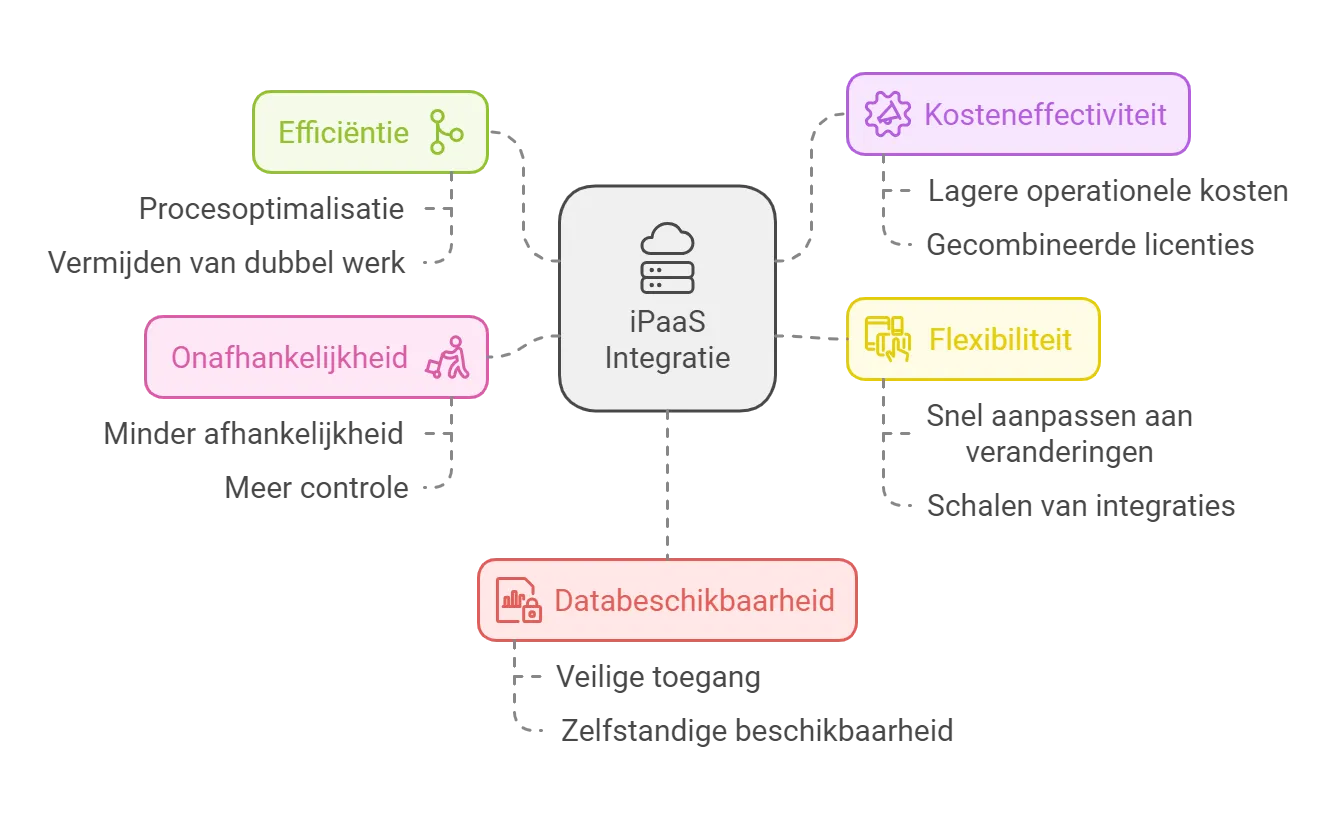
Although it is often still possible to work without an iPaaS today, the disadvantages can quickly take over as the number of integrations grows. Think of limited control of your own over information flows, rising costs, growing dependence on system suppliers, rigidity, inefficiency from duplicated work and no way to achieve 'your own' data availability.
By that last point, we mean the ability to make usable information securely available independently. This information (the puzzles) can be assembled from standardised, available building blocks (the puzzle pieces), independently of the specific source system.
After all, data availability is increasingly a necessity for modern healthcare organisations. The arrival of the Wegiz, the EHDS and data availability as a strategy makes the availability of 'puzzle pieces' from our information systems essential. Without the support of an iPaaS, however, it will be a challenge for organisations to put the information 'puzzles' together themselves. We run the risk of staying dependent on system suppliers' gateways, aggregators, brokers and translation engines, which can lead to specific exchange instead of generic availability.
An iPaaS is therefore an important consideration for healthcare organisations that want to take control of data availability and interoperability. It lets us respond flexibly and scalably to the growing demand for data exchange, without being entirely dependent on external parties.
So ask yourself: is an iPaaS a 'nice to have' for your organisation, or a necessary investment in the future of healthcare?
Harmony IT is an ICT service provider with a focus on healthcare. We support organisations in implementing and adopting the MuleSoft Anypoint Platform. In healthcare, we do this for organisations including the Sint Antonius hospital, RadboudUMC, Cordaan, Zorgcirkel and Omring. Samen Zorgen Voor Morgen is our healthcare service, within which we build solutions aimed specifically at the Dutch healthcare market, such as MITZ, Zibs, Cumuluz, etc., and through which we work to bring the Dutch MuleSoft and OutSystems healthcare community together. Interested in more information? Get in touch with us.