
When digital transformation (DX) programmes run into trouble, it is certainly not always down to technical or budget constraints. In fact, when we look for data points, we recently saw that only 35% of companies worldwide managed to achieve their DX goals (BCG, 2021). That is a sobering figure, and it shows that a fundamental piece is often missing.
That missing piece? Sometimes it is a well-thought-out and proven process approach. Because the organisations that do succeed make a smart combination of technology and recognised process optimisation methods such as Lean, Six Sigma, Agile and Design Thinking.
What is digital transformation, really?
Digital transformation is more than implementing new technology. It is a fundamental rethink of how organisations create value, supported by digital tools.
It is about:
- Process automation
- Data-driven decision-making (which is crucial, since 73% of consumers expect better personalisation as technology advances, Salesforce, 2024)
- New (digital) customer interactions
- Innovative business models
But without a clear process approach, digitalisation can lead to accelerated chaos instead of measurable improvement.
The power of process methods in DX
Here is how proven methods add value to digital projects:
1. Lean: eliminate waste before you digitalise
Lean focuses on eliminating waste and maximising customer value. In digital programmes, Lean helps to identify inefficient processes before they are automated.
- Value Stream Mapping to uncover bottlenecks and waiting times.
- Building a culture of continuous improvement (Kaizen).
- Minimising unnecessary steps in digital workflows
Companies with effective change management programmes (a pillar of Lean and Agile) achieve an average of 143% of the expected ROI (McKinsey).
So clean up first, then digitalise!
2. Six Sigma: safeguard quality and consistency
Six Sigma is aimed at reducing variation and improving the quality of the end product. By using data analysis and the DMAIC cycle (Define, Measure, Analyse, Improve, Control), digital processes can be improved in a measurable and lasting way.
- Applying DMAIC to digital workflows to reduce errors and rework.
- Data-driven approach: organisations that implement Six Sigma correctly see an average return of $230,000 per project and an ROI of 4.5 to 6 times on their training investment (SixSigma.us).
3. Agile and Design Thinking: flexibility and a focus on people
- Agile provides fast iteration, continuous feedback and collaboration between teams, which is essential in the fast-changing digital world.
- Design Thinking puts the end user at the centre and helps to design intuitive digital solutions. The goal: better adoption.
Companies that use Design Thinking focus on understanding user needs. That is crucial, because 41% of organisations invest in DX without properly researching their customers' needs (Prophet, 2019), which often leads to disappointing adoption.
The consultant as strategic process director
As a consultant, you can use these methods strategically in every phase of a digital transformation programme.
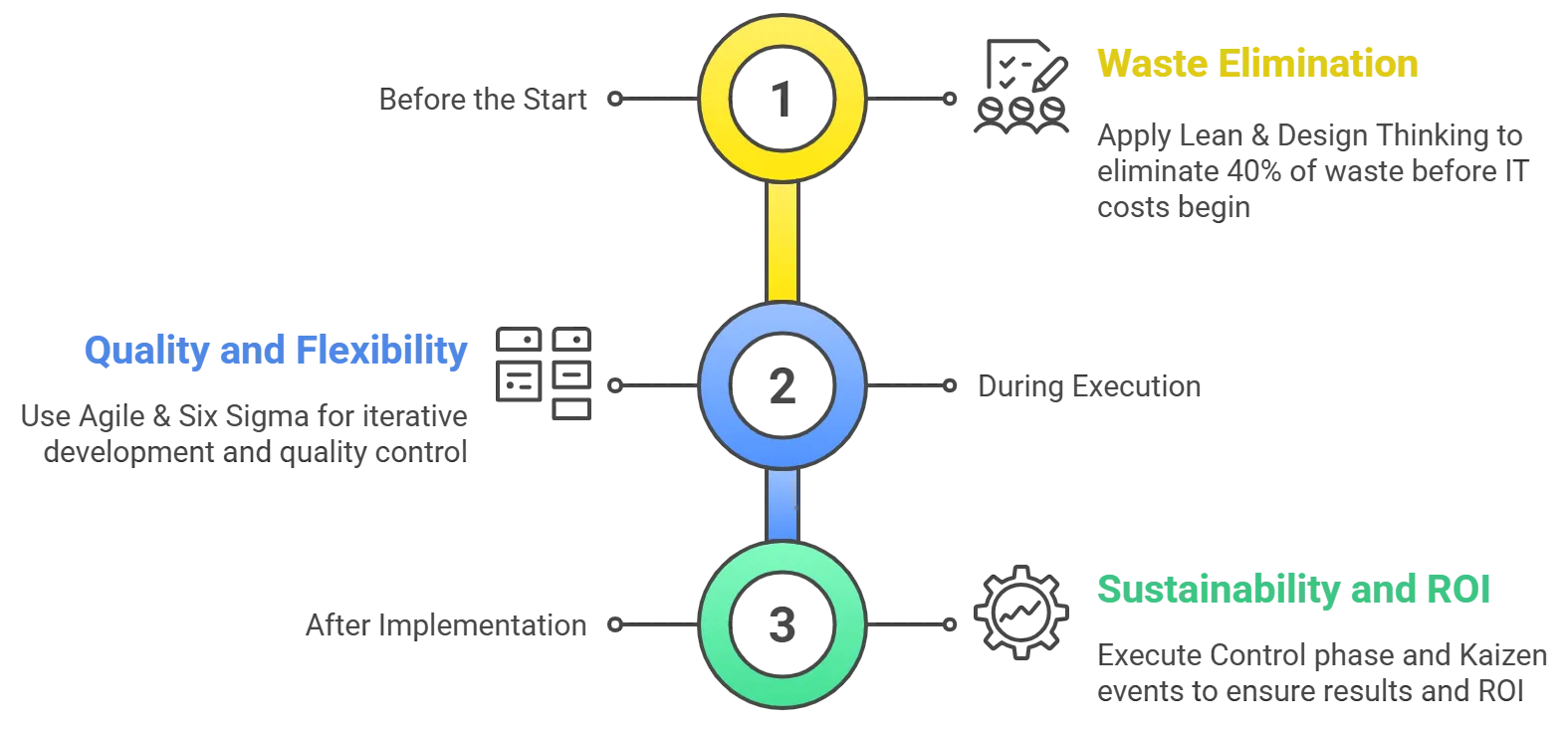
Whatever role you play in the digital transformation project you are working on as a consultant, it is always worth keeping the process methods above in the back of your mind.
- Lean: try to map the processes your project affects, and identify waiting times and unnecessary steps.
- Six Sigma: look at the product your project delivers. How much rework is there? What is the quality of the end product? Does every product have the same level of quality (variation)?
- Design Thinking: use Design Thinking techniques when you lead workshops that look for solutions.
- Agile: an agile way of working makes for fast development of the solutions, and short feedback loops also help with fast delivery.
A practical example: implementing an HR app
Say you are a Digital Transformation consultant guiding the implementation of a new HR app (payslips, absences and so on).
- Lean: you start with a Value Stream Map of the current process. You discover two unnecessary approval steps and four days of waiting time in the leave request process. These steps are removed before digitalisation.
- Six Sigma: during the test phase, you analyse data. You find that 15% of requests are submitted incorrectly because of confusing input fields. You apply the DMAIC method to analyse the source of the errors, improve the interface and reduce the error rate to less than 5% (the Six Sigma standard).
- Design Thinking: you organise workshops with the end users to co-create the interface. Using personas and Journey Mapping, you design an app that is intuitive, which speeds up adoption by 25% in the first month.
- Agile: you use Scrum. Every sprint delivers a working element. User feedback from the previous week goes into the next sprint, so the solution fits the need perfectly.
Conclusion
Digital transformation is not a goal in itself, but a means of creating measurable value. Integrating Lean, Six Sigma, Agile and Design Thinking allows consultants to:
- Avoid waste (Lean).
- Guarantee quality and ROI (Six Sigma).
- Achieve higher user adoption (Design Thinking).
In short: optimise first, digitalise second. Only then will you achieve lasting change, satisfied customers and measurable impact.